Whirlpool Dishwasher F2 E2 Error: Safe Troubleshooting
Written by
Editorial Team
Research and editorial staff
Dates
Last updated
What changed: Expanded the F2 E2 guide beyond 1,000 words and removed universal code meaning, unsafe door-panel work, fixed prices, reset success claims, board certainty, and warranty promises.
Checked by our editors.How we estimate repair costsEditorial policy
Sources
- Whirlpool product help — Whirlpool
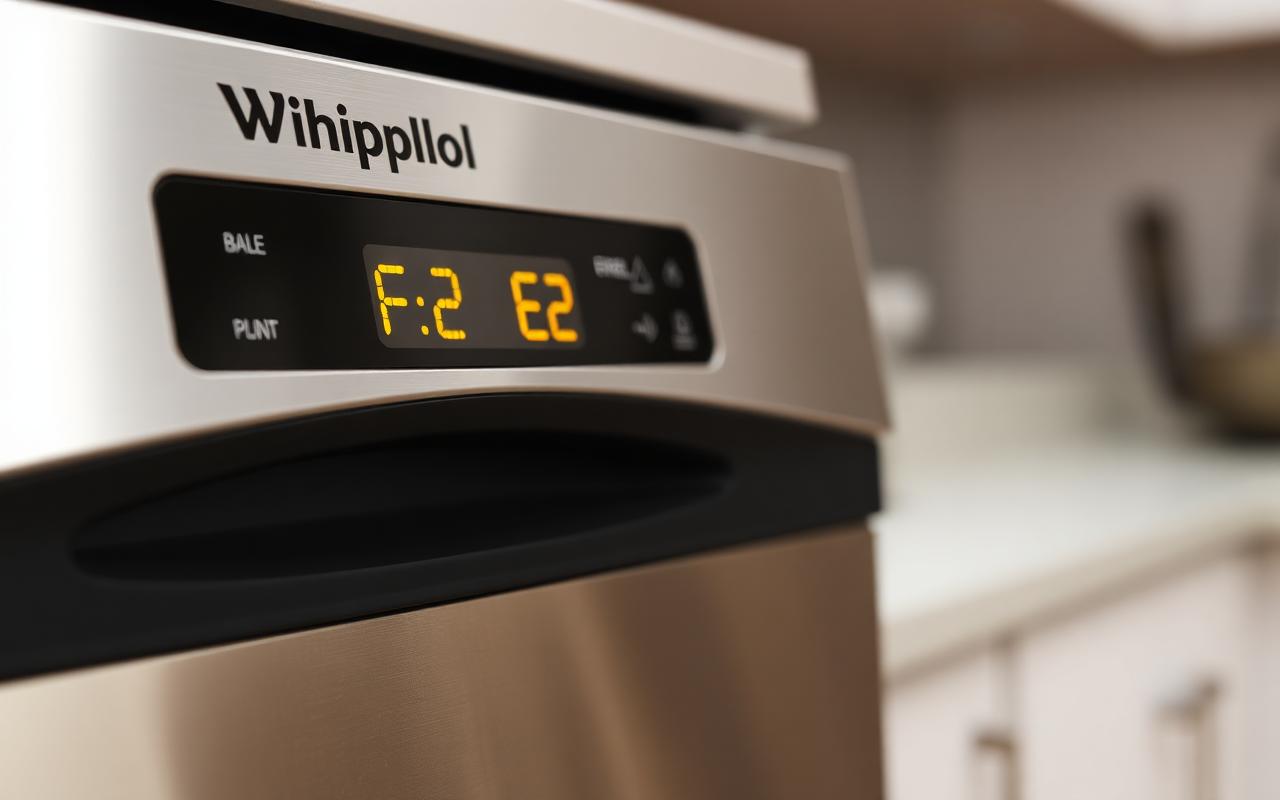
A Whirlpool dishwasher showing F2 E2 may have detected a communication problem involving electronic controls, but the exact definition depends on the full model, control platform, and market. A similar code, a separated display sequence, or a standalone F2 can mean something different.
Record exactly what appears and use Whirlpool documentation for the complete model. Do not assume that either the user interface or main control board must be replaced.
Immediate safety response
Stop using the dishwasher for smoke, burning odor, arcing, damaged wiring, repeated breaker trips, active leakage, or water near electrical components. Disconnect power at an accessible plug or breaker only when safe.
If water is present, avoid wet electrical areas and close the accessible supply valve where safe. Follow emergency guidance for fire or shock risk.
Find the complete model number
Locate the rating label where Whirlpool specifies, often along the door or frame. Record the full model and serial number, including suffixes.
Use Whirlpool Product Help and the exact owner manual. Closely related models may use different control boards, interfaces, connector layouts, reset procedures, and fault definitions.
Record the full display sequence
Photograph or video the code and note:
- Whether F2 and E2 alternate
- Any other code shown
- Indicator-light pattern
- Cycle and option selected
- When the code appears
- Whether buttons respond
- Whether the pump, valve, or motor operates
- Recent power interruption
- Moisture, leakage, or steam exposure
- Previous intermittent control behavior
Do not shorten the code when contacting support.
Verify the model-specific meaning
On some Whirlpool dishwasher platforms, F2 E2 can indicate communication trouble between the user interface and electronic control. That communication path may include the interface, main control, wiring harness, connectors, power supply, grounding, moisture exposure, and software state.
The code is not proof that one board failed. Qualified diagnosis should evaluate the complete circuit.
Use only the approved reset
Consult the manual for canceling a cycle, keypad reset, or power interruption. A reset can clear a temporary state caused by a power disturbance or control lockup.
If F2 E2 returns, stop repeating resets and arrange diagnosis. A reset cannot repair damaged wiring, loose terminals, corrosion, moisture intrusion, failed controls, or an unstable electrical supply.
Do not open the door panel casually
Dishwasher doors contain electrical wiring, sharp sheet metal, springs, insulation, and mounted controls. Some units are hardwired, and a mislabeled breaker can create shock risk. Door disassembly can also disturb seals or damage cables.
Internal inspection should be performed by a qualified technician using model-specific service information and verified power isolation. Avoid generic instructions to reseat an unnamed connector.
Moisture and leakage
Steam, a door leak, condensation, spilled liquid, or internal leakage can affect electronic connections. If the code followed visible moisture, document the location and stop operating the appliance until the source is evaluated.
Simply allowing the unit to dry does not establish that it is safe or that corrosion and leakage are resolved. Do not apply heat to controls.
Power-supply conditions
Loose supply connections, damaged cords, hardwiring faults, grounding issues, breaker problems, or voltage disturbances can affect electronic communication. These conditions require qualified electrical evaluation.
Do not repeatedly reset a tripping breaker. Do not probe live terminals.
User-interface possibility
The user interface includes buttons, touch controls, displays, and associated electronics. A nonresponsive key, intermittent display, or communication code may involve the interface, but wiring, supply, or main control can create the same symptom.
Ask how the technician isolated the interface before authorizing replacement.
Main-control possibility
The main control operates loads and communicates with the interface. It can fail, but a board replacement should follow verification of power, wiring, connectors, moisture, and interface behavior.
Electronic parts can be costly and may have restricted returns. Require the exact part number and diagnosis.
Wiring and connectors
Harness damage, loose terminals, pin fit, corrosion, moisture, or door movement can interrupt communication. A technician should inspect the path and use approved tests.
Repair may involve a connector or harness rather than either control board. Do not assume that reseating alone is a permanent remedy if there is heat or corrosion damage.
Door-harness movement
Wiring that passes through or near the door can experience repeated movement. The exact routing, clips, insulation, and strain relief are model-specific.
A qualified technician should inspect for abrasion or pinching and restore routing according to service information.
Related symptoms
Record whether the dishwasher is completely dead, displays lights but ignores buttons, starts and stops, runs the drain pump, or shows the code immediately or later. These patterns can guide diagnosis.
Do not energize an opened door assembly to observe behavior.
Installation-related conditions
If the code began after installation, moving, cabinet work, flooring, door service, or an electrical event, document the timing. Pinched wiring, stressed connections, water entry, supply issues, or incorrect mounting may be relevant.
Contact the installer where appropriate and retain invoices and photographs.
What a diagnosis should include
Request a written report identifying:
- Model-specific F2 E2 definition
- Power-supply findings
- Interface test results
- Main-control findings
- Harness and connector condition
- Moisture or installation contribution
- Required repair
- Exact part numbers
- Complete estimate
- Repair warranty
A report that says only “communication error” does not identify the failed component.
Repair cost
There is no dependable universal F2 E2 repair price. Cost depends on whether the remedy is an approved reset, electrical correction, moisture repair, connector, harness, user interface, main control, door access, or replacement.
Obtain an itemized local quote covering diagnosis, parts, labor, shipping, tax, removal, reassembly, leak inspection, and functional testing.
Repair or replace
Compare the written diagnosis and complete repair cost with installed replacement. Consider the dishwasher's condition, prior failures, parts availability, manufacturer coverage, panel and cabinet compatibility, timing, and repair warranty.
Do not use one age, price, or percentage threshold automatically.
Manufacturer warranty and recalls
Check the issued warranty, purchase date, registration, parts and labor terms, installer warranty, authorized-service requirements, and official recall notices. Use the complete model and serial range.
Contact Whirlpool before unauthorized internal work when coverage may apply. F2 E2 does not guarantee a specific remedy.
Home-warranty coverage
A service contract may cover a listed dishwasher and eligible electronic component, subject to cause, effective date, maintenance, installation, service fee, limits, exclusions, and authorization.
Moisture, external power, access, unauthorized work, or resulting damage may be handled separately. Review the agreement before non-emergency service.
Property damage
If moisture or an electrical event caused damage beyond the dishwasher, the appliance failure and resulting property damage may be treated separately by a warranty, homeowners insurance, installer, electrician, or no coverage.
Mitigate safely, photograph conditions, preserve evidence, and notify relevant providers. Do not assume one approval covers all damage.
After repair
Obtain the final diagnosis, part numbers, invoice, test results, and repair warranty. Confirm that the technician completed model-specific keypad, communication, cycle, and leak tests.
Monitor initial operation according to service guidance. Stop if the code, moisture, burning odor, or breaker issue returns.
Prevention
Follow the Whirlpool manual for loading, detergent, venting, filter care, cleaning, door use, and installation. Avoid directing water or cleaner toward the control area.
Correct use and maintenance can reduce avoidable moisture and mechanical problems but cannot prevent every wiring or electronic fault.
Questions for Whirlpool or the technician
- What does F2 E2 mean for this exact model?
- Were all display characters recorded correctly?
- Was the electrical supply verified?
- Were the interface and main control tested separately?
- Was the full harness inspected?
- Was moisture or installation involved?
- Is the appliance safe to reconnect?
- What exact parts are required?
- What warranty applies?
- What is the complete repair total?
Final guidance
Treat Whirlpool F2 E2 as a model-specific diagnostic code, not proof that one control board failed. Preserve the display, use the official reset once where appropriate, and obtain qualified diagnosis if it returns.
Avoid opening energized door panels, generic connector instructions, repeated resets, and board replacement based only on the code.
Related articles
- Dishwasher Error Codes
- Dishwasher Repair Cost Guide
- Repair or Replace a Dishwasher?
- Does a Home Warranty Cover a Dishwasher?
Disclosure: This article is informational and not a substitute for Whirlpool instructions or qualified service. The site may earn a commission from eligible links. Commercial relationships do not determine the guidance.
Frequently asked questions
Related guides
Bosch Dishwasher E15 Error Code: Safe Troubleshooting
Learn how to respond safely to a Bosch dishwasher E15 code, verify its model-specific meaning, document leakage, check approved basics, and arrange service.
Dishwasher Error Codes: A Safe Troubleshooting Guide
Learn how to interpret dishwasher error codes safely, locate the correct model manual, check water and drainage basics, document faults, and decide when to call a technician.
GE Oven F3 Error Code: Safe Troubleshooting
Learn how to respond safely to a GE oven F3 code, verify its model-specific meaning, document the fault, use approved resets, and arrange qualified diagnosis.
Disclaimer: Pricing reflects US national averages as of the publication date and varies by region, brand, and labor rates. This article is informational and does not replace professional inspection or repair advice. See our full disclaimer.