GE Oven F3 Error Code: Safe Troubleshooting
Written by
Editorial Team
Research and editorial staff
Dates
Last updated
What changed: Expanded the F3 guide beyond 1,000 words and removed universal code meaning, fixed resistance values, DIY live testing, fixed repair prices, component certainty, and warranty promises.
Checked by our editors.How we estimate repair costsEditorial policy
Sources
- GE Appliances service and support — GE Appliances
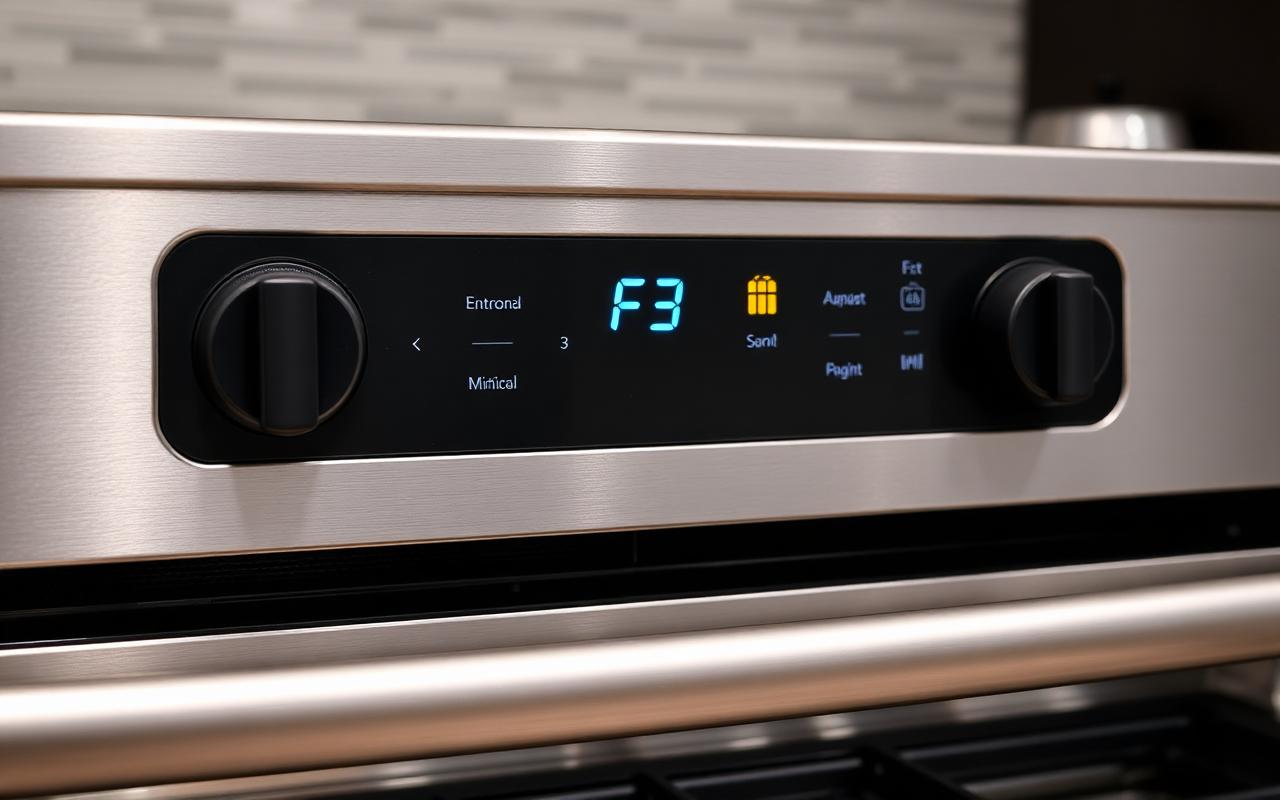
A GE oven displaying F3 may have detected a temperature-sensing or related circuit condition, but the exact meaning is model-specific. GE has produced many ranges, wall ovens, control platforms, and regional variants. A generic code chart cannot safely substitute for the documentation tied to the full model number.
Treat the code as diagnostic information. Do not replace a sensor or control board from the display alone.
Immediate safety response
Stop using the oven if it overheats, heats unexpectedly, fails to shut off, smells burned, smokes, arcs, has damaged wiring, or repeatedly trips a breaker. Disconnect power at the breaker only when safe.
If a gas appliance has a gas odor, follow utility and emergency guidance. Do not operate switches or attempt a repair in a suspected gas atmosphere.
Ovens can use high voltage, gas, high temperatures, heavy doors, and sharp metal. Internal testing and repair require appropriate qualifications.
Find the complete model number
Locate the rating label where GE specifies for the product, which can vary among ranges, wall ovens, and cooktops. Record the entire model and serial number.
Use GE Appliances support to find the correct owner manual, service information available to consumers, warranty, and contact options. Similar model names can use different sensors, controls, and fault definitions.
Record the fault
Before resetting, photograph the display and note:
- Exact code and any alternating characters
- Cooking mode
- Set temperature
- Whether the oven was preheating, baking, broiling, cleaning, or idle
- Whether heat stopped or continued
- Actual temperature observations, if safely available
- Sounds, odors, or visible damage
- Recent power interruption or repair
- How often the fault occurs
Some controls store historical faults. Follow model-specific instructions rather than guessing a keypad sequence.
Verify the model-specific definition
On some platforms, F3 can relate to an oven-temperature sensor circuit or reading. That circuit can include the sensor, connectors, wiring harness, control, and physical installation.
The code does not automatically prove that the probe itself failed. Open or shorted wiring, poor connections, heat damage, moisture, or a control-reading problem can produce related symptoms.
Use only the official reset procedure
Consult the manual for cancel, reset, or power-interruption instructions. A reset may clear a temporary state after a power disturbance.
If the code returns, stop repeated resets and arrange diagnosis. A reset cannot repair damaged wiring, a failed sensor, a loose connector, a control problem, or uncontrolled heating.
Do not use a universal resistance value
Sensor resistance varies with temperature and must be interpreted using the correct model specification, measurement location, disconnected-circuit procedure, meter, and service information. A single value copied from another model can lead to a false diagnosis.
Do not probe energized circuits. A qualified technician should isolate the circuit, confirm actual temperature, inspect connectors and wiring, and compare readings with the appropriate technical data.
Temperature-sensor inspection
When the oven is cool and power is confirmed off, an owner may visually inspect only areas the manual permits. Do not pull wiring through the cavity or remove panels without model-specific guidance and suitable skill.
A probe touching a wall, damaged mounting, heavy contamination, or visible connector damage may be relevant, but none alone proves the complete diagnosis.
Wiring and connectors
Heat, movement, corrosion, loose terminals, pin damage, or previous repair can affect the sensor circuit. Wiring faults can mimic a failed sensor.
A technician should inspect the full path and perform appropriate continuity, insulation, and connection checks under safe procedures. Replacing the sensor without checking wiring can leave F3 unresolved.
Control-board possibility
The electronic control interprets the sensor signal and operates heating components. A control fault is possible, but it should not be assumed before the sensor circuit, supply, connectors, and relevant loads are evaluated.
Control boards can be expensive and may have strict return rules. Require a documented diagnosis before replacement.
Heating components and relays
Unexpected heating or failure to regulate can involve more than the sensing circuit. Heating elements, relays, valves, wiring, and controls may need evaluation depending on the model and symptom.
If heat continues after cancellation, disconnect the appliance safely and seek prompt service. Do not continue using it.
Calibration versus fault diagnosis
Normal cooking variation or a modest temperature offset is different from an F3 fault. Calibration features can adjust ordinary performance on some models, but they do not repair an open circuit, damaged wiring, failed control, or uncontrolled heating.
Use the manual's calibration method only after safety faults are ruled out.
Gas and electric models
Electric ovens may use high-voltage elements and relays. Gas ovens may use igniters, valves, flame systems, and electrical controls. Dual-fuel products combine hazards.
The F3 display should be evaluated in the context of the appliance design. Use technicians qualified for the fuel type.
Wall ovens and built-in access
Built-in wall ovens may require careful removal, cabinet protection, power disconnection, and multiple people. Do not pull a heavy oven forward solely to reach a connector without the correct support and procedure.
Ask whether removal, reinstallation, trim, calibration, and operational testing are included in the service quote.
What a diagnosis should include
Request a written report stating:
- Model-specific meaning of F3
- Actual failed component or connection
- Evidence and test specification
- Wiring and connector condition
- Control and heating evaluation where relevant
- Safety status
- Required repair
- Parts availability
- Complete estimate
- Repair warranty
“F3 means sensor” is not enough by itself.
Repair cost
There is no dependable universal F3 repair cost. The result can range from a corrected connection or model-approved reset to sensor, harness, control, heating, access, or installation work.
Ask for an itemized local quote covering diagnosis, part number, labor, built-in removal, reinstallation, shipping, tax, calibration, and safety testing.
Repair or replace
Compare the complete repair quote with complete installed replacement. Consider appliance type, current condition, prior failures, parts availability, remaining warranty, cabinetry, fuel, electrical supply, ventilation, trim, and timing.
Do not use one age, price, or percentage threshold automatically. A contained sensor-circuit repair can suit an older oven, while extensive heat or wiring damage can make a newer unit impractical.
Manufacturer warranty and recalls
Check the issued warranty, purchase date, registration, parts and labor terms, authorized-service rules, installer warranty, and official recall notices. Use the complete model and serial range.
Contact GE before unauthorized work when coverage may apply. An error code does not guarantee a particular remedy.
Home-warranty coverage
A service contract may cover a listed oven and eligible component, subject to cause, effective date, fuel type, service fee, limits, exclusions, maintenance, installation, and authorization.
The administrator may choose repair, replacement, reimbursement, or cash settlement. Obtain approval before non-emergency outside repair when required.
Documentation for a claim
Save the display photograph, model information, symptom timeline, temperature observations, manual, diagnosis, estimate, prior repair records, and communications.
Describe what happened without stating an unverified cause. Accurate evidence is more useful than a generic code explanation.
After repair
Obtain the replaced part number, final diagnosis, invoice, test results, and warranty. Confirm that the technician completed the model-specific functional and safety checks.
Monitor initial use according to service guidance. Stop if F3, uncontrolled temperature, odor, smoke, or breaker problems return.
Prevention and ordinary use
Follow the manual for cookware, rack position, cleaning, ventilation, power, calibration, and self-clean operation. Avoid foil or liners placed in prohibited locations.
Maintenance and correct use can prevent some performance problems but cannot prevent every sensor, wiring, connector, or control failure.
Questions for GE or the technician
- What does F3 mean for this exact model?
- Which technical specification applies?
- Was the sensor tested at a known temperature?
- Were connectors and wiring checked?
- Was the control or heating circuit evaluated?
- Is the oven safe to use?
- Is the exact part available?
- Is built-in access included?
- What warranty applies?
- What is the complete repair total?
Final guidance
Treat GE F3 as a model-specific diagnostic code, not proof that one sensor or board has failed. Stop unsafe operation, preserve the code, locate the full model, and use official information and qualified diagnosis.
Avoid generic resistance values, energized DIY testing, repeated resets, and parts replacement based only on the display.
Related articles
- Oven & Stove Repair Cost Guide
- Repair or Replace an Oven?
- What Appliances Does a Home Warranty Cover?
Disclosure: This article is informational and not a substitute for GE instructions or qualified service. The site may earn a commission from eligible links. Commercial relationships do not determine the guidance.
Frequently asked questions
Related guides
Bosch Dishwasher E15 Error Code: Safe Troubleshooting
Learn how to respond safely to a Bosch dishwasher E15 code, verify its model-specific meaning, document leakage, check approved basics, and arrange service.
Dishwasher Error Codes: A Safe Troubleshooting Guide
Learn how to interpret dishwasher error codes safely, locate the correct model manual, check water and drainage basics, document faults, and decide when to call a technician.
LG Washer OE Error Code: Safe Troubleshooting
Learn how to respond safely to an LG washer OE code, verify its model-specific meaning, drain retained water, inspect approved items, and arrange diagnosis.
Disclaimer: Pricing reflects US national averages as of the publication date and varies by region, brand, and labor rates. This article is informational and does not replace professional inspection or repair advice. See our full disclaimer.