Should You Repair or Replace a Dryer?
Written by
Editorial Team
Research and editorial staff
Dates
Last updated
What changed: Expanded the decision guide beyond 1,000 words without unsupported fixed prices, lifespan rules, universal diagnoses, efficiency claims, warranty promises, or automatic thresholds.
Checked by our editors.How we estimate repair costsEditorial policy
Sources
- U.S. Fire Administration appliance and electrical fire safety — U.S. Fire Administration
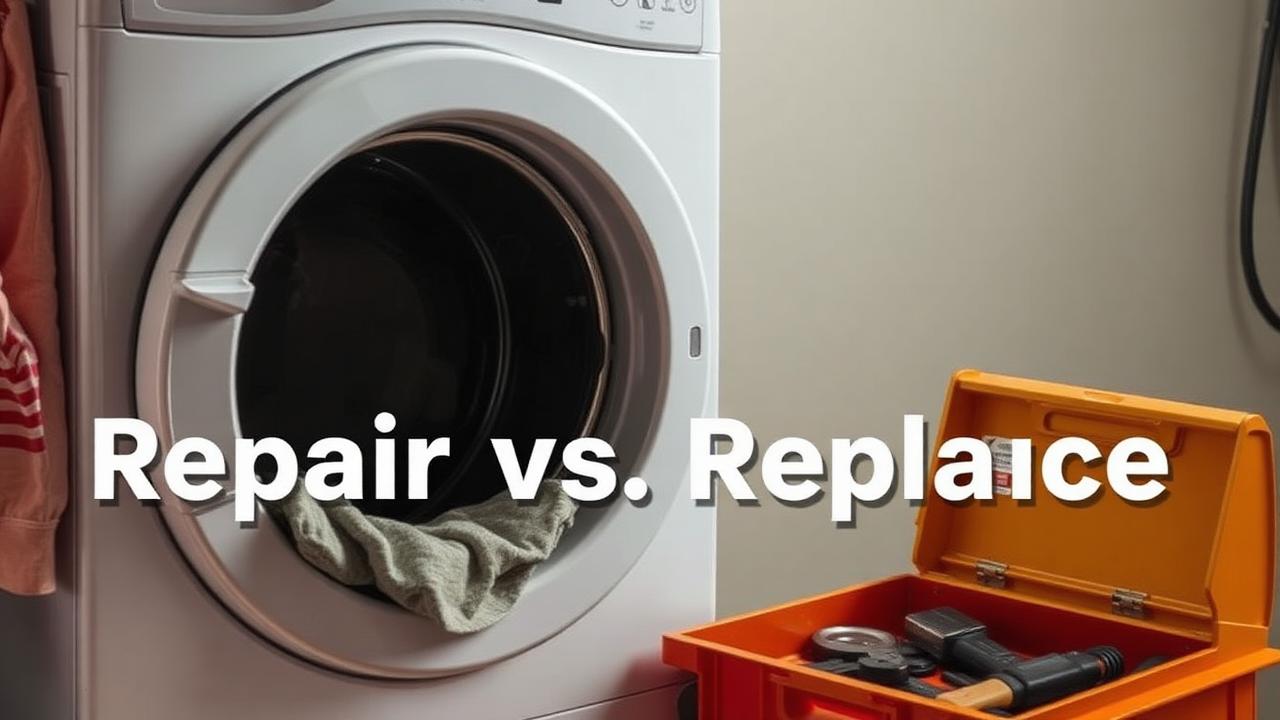
A clothes-dryer repair-or-replace decision begins with safety and diagnosis. “No heat,” “no spin,” noise, or long drying time can involve airflow, power, gas supply, heating, sensors, controls, motors, belts, bearings, or installation. Generic ages and prices cannot decide the outcome.
Compare complete repair with complete installed replacement for the exact model and home.
Address hazards first
Stop using the dryer for smoke, burning odor, scorching, arcing, repeated breaker trips, gas odor, damaged wiring, uncontrolled heat, or a visibly unsafe vent.
Follow gas-utility and emergency guidance when gas is suspected. Do not operate switches in a hazardous atmosphere, bypass a safety device, or keep resetting a breaker. Qualified service should handle gas and internal high-voltage work.
Check the exhaust system
Restricted or unsuitable venting can reduce performance and create a fire hazard. Review the model instructions and applicable code for material, length, bends, termination, clearance, and shared-vent restrictions.
A part replacement without correcting the root airflow problem may not last. Include vent inspection or correction in both repair and replacement quotes when necessary.
Get a written diagnosis
Ask the technician to identify the failed component, cause, evidence, safety concern, vent or utility issue, required work, parts status, and repair warranty.
A thermal protection device opening may be a result of overheating rather than the complete diagnosis. A drum that does not turn can involve more than a belt.
Identify the exact dryer
Record the manufacturer, full model and serial number, gas or electric fuel, voltage, installation, vent route, approximate age, prior repairs, symptoms, and existing coverage.
Note stacked, closet, built-in, pedestal, or matching-set constraints. Closely related models can use different parts.
Complete repair cost
Include diagnosis, part, labor, shipping, tax, moving, unstacking, gas or electrical disconnection, vent work, reconnection, leak or safety tests, and warranty.
Ask whether the diagnostic fee is credited and whether another condition could damage the new component.
Installed replacement cost
Include the appliance, delivery, haul-away, stacking kit, pedestal compatibility, cord, receptacle work, gas connector, shutoff work, vent transition, duct correction, permits, code work, and tax.
Confirm fuel, voltage, dimensions, door swing, capacity, and vent path. Retail price alone is incomplete.
No heat
Electric no-heat conditions can involve supply voltage, heating components, thermal protection, sensors, wiring, controls, or airflow. Gas no-heat can involve supply, ignition, flame sensing, valves, controls, wiring, or airflow.
Do not replace an element or igniter from the symptom alone. Obtain model-specific testing by a qualified person.
Long drying time
Load size, washer spin performance, cycle settings, lint screen, venting, room conditions, fuel or power, heating, moisture sensors, and controls can affect time.
Correcting airflow or laundry practices may restore performance without replacing the dryer. Persistent weak airflow requires safe investigation.
Drum does not turn
Possible causes include loading, belt, rollers, idler, motor, blower obstruction, controls, or power. Stop repeated attempts if the motor hums, overheats, or smells.
The estimate should identify whether related wear parts should be replaced together and why.
Noise
Rumbling, scraping, squealing, clicking, and thumping can arise from load objects, rollers, glides, idler, belt, motor, blower, drum, or cabinet contact.
Record when the noise occurs. Do not operate a dryer that is damaging itself or overheating.
Gas versus electric replacement
Changing fuel type can require new electrical service, gas work, ventilation review, permits, and building modifications. Compare this separately from replacing like for like.
Do not assume a fuel switch will reduce cost without calculating local utility, equipment, and installation factors.
Parts availability
Confirm the exact part number, condition, supplier, lead time, return policy, and warranty. Older or specialty models may have delayed or unavailable controls, drums, or motors.
Unavailable parts can favor replacement, but ask whether authorized alternatives or rebuild services exist.
Current condition
Inspect drum, cabinet, wiring, controls, door, seals, lint path, rollers, motor, gas or electrical connection, and vent. One isolated fault differs from fire damage, corrosion, repeated overheating, or several worn systems.
Use documented condition rather than assuming more failures from age alone.
Repair warranty
Ask who warrants parts and labor, for how long, and what happens if the same symptom returns. Determine whether travel or another diagnostic fee applies.
A repair warranty reduces limited risk but does not cover unrelated future faults.
Manufacturer and recall coverage
Check manufacturer parts and labor terms, motor or drum provisions, installer warranty, retailer plan, credit-card benefit, recall remedy, and authorized-service rules.
Use the exact model and serial range. Obtain required authorization before repair.
Home-warranty coverage
A service contract may cover an eligible dryer component, subject to fuel type, cause, effective date, maintenance, venting, service fee, limit, exclusions, and authorization.
External ducts, gas lines, cords, access, and resulting damage can be treated separately. Compare the written approval with total project cost.
Fire or property damage
The dryer failure and damage to walls, clothing, structure, or belongings may be treated differently by the warranty, homeowners insurance, manufacturer, installer, or no coverage.
Protect life, document conditions when safe, preserve evidence, and notify relevant providers. Do not count uncertain payment in the decision.
Matching and stacking
Replacing one appliance can affect stacking kits, pedestals, dimensions, controls, finish, door swing, and capacity relative to the washer. A repair agreement may not replace a matching washer.
Compatibility can add real installation cost even when appearance alone is optional.
Efficiency
Use official energy labels for the exact replacement and local utility rates. Conventional, ventless, and heat-pump products can differ in cycle time, electrical needs, moisture handling, maintenance, and installation.
Do not rely on a universal payback claim. Calculate expected use and total cost.
Timing
Compare technician availability, part lead time, replacement stock, delivery, installation, and vent or utility work. A product in stock may still require site changes.
Ask for realistic schedules without treating them as guarantees.
Repeated failures
List previous diagnoses, repairs, and costs. Distinguish a repeated root cause—such as unresolved airflow—from unrelated component wear.
Repeated expense can favor replacement, but evidence is stronger than prediction.
Environmental considerations
Repair can extend product life and avoid disposal. Replacement can improve standardized efficiency or support a safer installation. Local recycling, actual use, and product condition matter.
Neither choice is universally better environmentally.
Decision worksheet
Compare safety, complete cost, parts, warranty, timing, vent correction, utility work, remaining usefulness, efficiency, matching, and household preference. Mark unknowns.
Run no-coverage and approved-coverage scenarios separately.
Questions for the technician
- What failed and why?
- Is airflow, gas, or electrical supply involved?
- Is the dryer safe?
- Is the part available?
- Is access and reconnection included?
- What tests follow repair?
- What warranty applies?
- What is the complete repair total?
Questions for the installer
- Does the replacement fit and match the fuel and voltage?
- Is the vent suitable?
- Are cord, connector, stacking, and permits included?
- What site work is required?
- What is the complete installed total?
Final guidance
Repair can fit when the diagnosis is clear, the dryer is otherwise sound, the root cause is corrected, parts are available, and total cost is acceptable. Replacement can fit when damage is extensive, safety cannot be restored economically, multiple failures exist, or parts and installation favor a new unit.
No single age, component, or percentage rule decides every dryer.
Related articles
- Dryer Repair Cost Guide
- Does a Home Warranty Cover a Washer and Dryer?
- Repair or Replace a Washing Machine?
Disclosure: This article is informational and not a substitute for qualified diagnosis or installation. The site may earn a commission from eligible links. Commercial relationships do not determine the guidance.
Frequently asked questions
Related guides
Should You Repair or Replace an Oven?
Decide whether to repair or replace an oven, range, or cooktop using diagnosis, complete quotes, gas and electrical safety, parts, coverage, installation, and needs.
Should You Repair or Replace a Dishwasher?
Decide whether to repair or replace a dishwasher using a written diagnosis, complete repair and installation quotes, condition, parts, coverage, and safety.
Should You Repair or Replace a Refrigerator?
Decide whether to repair or replace a refrigerator using diagnosis, complete quotes, food safety, parts, coverage, energy use, installation, and household needs.
Disclaimer: Pricing reflects US national averages as of the publication date and varies by region, brand, and labor rates. This article is informational and does not replace professional inspection or repair advice. See our full disclaimer.